Temperature regulation is a great example of how this homeostatic reflex works. If you go to the doctor at a hospital, the first thing they do is stick a thermometer in your mouth. They don’t even know why you’re there but they do that because the body temp is just that important. Our oral body temp is about 98.6°F. The core body temperature (rectum) is 99.6°F (usually done with babies.) What about the temperature on the surface of our skin? The air around us is almost always cooler than our bodies. Remember energy production is constantly generating heat, losing about 60% as heat during oxidative phosphorylation. The temperature on the surface of our skin is usually about 10 degrees lower than our body. There are thermometers nowadays that could check the surface of your skin and correspond that to an oral temp.
Daily (Diurnal) variations in body temperature
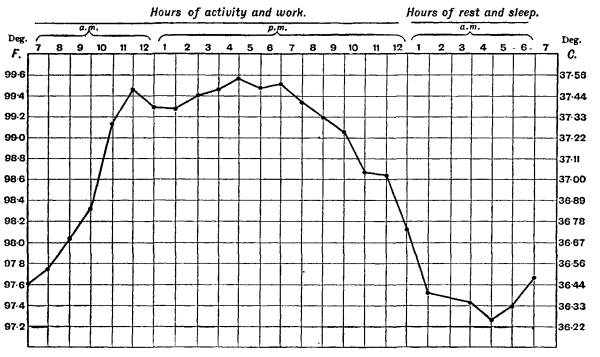
Normally your body temp is highest at the end of your work day, about 7PM. Your body temperature starts to drop afterwards until you start to sleep and it continues to drop until a couple hours before you rise from sleep (about 4am).
Why would the temperature be coolest a couple hours before you awake and not just before it? Because you have an internal clock in your brain that knows when you’re going to wake up and starts to speed metabolic activity up ahead of time. If you go to sleep consistently, you will wake up at the same time, usually just before the alarm you have set due to this internal clock.
Since we said your body temp is highest at the end of your work day… What if you work the graveyard shift? Your body temperature is still going to highest at the end of your work day. So if you get off work at 2AM, it will be highest around then.
Monthly variations in body temp in women
In women specifically, there is a monthly variation that is affected by the menstrual cycle. During the latter two weeks of their menstrual cycle (during the postovulatory luteal phase), the increase in progesterone causes a 1°F rise in basal body temperature. The basal body temperature is the lowest body temperature during sleep. A woman could take their temperature every morning and the day they wake up and find that their temperature is one degree higher than the day before, then they know they are ovulating. This is cheaper than using an ovulation test kit. If a woman gets pregnant, their body temperature stays elevated for the entire 9 months because the progesterone stays at high levels to prevent menstruation from occurring.
Relevant: The Menstrual Cycle in Detail
Three major sources of heat within the body
1. Cellular respiration is occurring in EVERY cell of your body. When glucose releases energy, more than half of the energy (60%!) is given off as heat which is why your body is nearly 100°F in temperature! Just like a light bulb that is fed with electricity, most of the energy is given off as heat instead of light.
2. Muscular activity generates heat for 2 reasons. (1) When you start to exercise or use your muscles, it increases cellular respiration to generate more ATP. (2) It also generates heat through something called “frictional heat” which is heat due to movement. The same thing happens when you’re driving your car and the tires of your car get hot because they’re touching the asphalt. This doesn’t generate as much heat as cellular respiration when you’re resting, but it’s something.
3. Ingestion of food. The very process of digesting the food that you eat, absorbing the nutrients, and processing those nutrients generates heat. The metabolic rate increases 10-20% due to the energy “costs” of these reactions. It’s not only cell respiration but ALL biochemical reactions generate heat. This effect, known as food-induced thermogenesis, is greatest after eating a high protein meal and is less after eating carbohydrates and lipids.
Exercise may also increase the metabolic rate up to 15 times the basal rate (professional athletes may do up to 20 times).
Four major methods of heat loss from the body
1. Radiative heat loss from the skin. Heat flows from an area that’s warmer to an area that’s colder. That’s radiation and it’s just like diffusion (high pressure to lower pressure). Your body temperature is almost always cooler than the air around you. Only on the rarest of days in Los Angeles is the air around you warmer. At 70F (21C), about 60% of heat loss occurs via radiation. If the air temperature was actually warmer than you, like say during a summer day in Las Vegas, then the heat would transfer onto you from the air.
2. Cutaneous vasodilation. All blood vessels in the body are capable of dilating or restricting.
Our body can affect or control how much blood flows through our cutaneous vessels (the vessels close to our skin). If the vessel is dilated, that’s vasodilation. If it constricts, that’s vasoconstriction. When we’re hot, we could increase the rate at which we lose heat to the air by dilating the vessels, which means more hot blood flows through our skin and our skin will look flushed. If you immerse your hands in hot water, the vessels dilate to get rid of the heat. Conversely, if we constrict the blood vessels, and reduce the amount of blood that’s flowing through our skin, that will reduce the amount of heat loss. If you put your hands in ice cold water, your hands will look white because of the vasoconstriction.
3. Evaporation of sweat from the skin. In order for sweat to work, the heat from your body has to cause the sweat from your body to evaporate. Let me give you an analogy, let’s say you put a pot of water on the stove and you turn on the flame. The heat from the flame is transferred to the water. As the water gains heat, the water molecules start to vibrate and move faster and faster and as they gain this kinetic energy, the water undergoes a phase change, going from liquid to a vapor/gas state. It takes energy to make something go from solid to liquid to gas. The water has gained enough energy for it to evaporate. When we sweat, we release water onto our skin, the heat of our body transfers to our sweat and causes the sweat to undergo a phase change from liquid to vapor and we get rid of the sweat and heat at the same time.
One factor slows this effectiveness of this: Humidity. The more humid the air, the slower the rate at which sweat evaporates. When you have 100% humidity, instead of water evaporating into the air, the water will condense and fall as rain. This is why most people can handle dry desert heat better than humid heat. Anywhere on the east-coast or the south in the summer feels like a steam room. The sweat doesn’t evaporate and everything just rolls down and your clothes stick to you. Sweating only cools you down if the heat of your body causes that water to evaporate. If the air temperature is hotter than you AND it’s really humid, then it feels like you’re going to die (haha).
4. Breathing. Go ahead and exhale on your hand. Feel how warm and humid it is? Every time we exhale, we lose water and heat from our body. About 20% of our body heat is lost due to exhaling. The lungs are the coolest parts of our body. Animals that cannot sweat, such as dogs, change their breathing pattern to get rid of heat and pant. If you have experience with a horse you’ll know that horses sweat and don’t pant. Since we aren’t aware of this water loss through the skin and mucous membranes of the mouth and respiratory tract, it is called insensible water loss.
The Thermoregulatory Reflex Center
The temp control center is found in the hypothalamus of our brain. Whenever the body temp becomes lower or higher than the set point level, the TRC activates effectors to compensate and return the body temperature back to the set point level. The job of this TRC center is to regulate the body of the temperature at a set point of 98.6 degrees F. In order to do this it needs to get this information from thermoreceptors (through an afferent pathway) in the rest of our body.
All the control center does is it COMPARES the actual body temperature with the desired body temperature. If they match, the control center doesn’t have to do anything. If they don’t match, then its job is to get the temp back to the set point. The TRC will send output signals across a motor pathway (an efferent pathway) to effectors such as cutaneous blood vessels, sweat glands, skeletal muscles (shivering) and glands (that secrete hormones that speed up cellular respiration).
Remember the mnemonic: A comes before E in the alphabet, so signals are sent through an Afferent pathway (input) to the control center and then the output goes through an Efferent pathway to the effectors (muscles and glands).
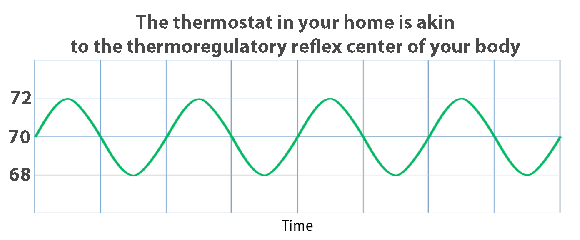
Incidentally the analogy we’re going to draw from this is the thermostat in your home. If you have your thermostat set to 70, the actual temperature of your home will look like this above. The heater doesn’t turn on until it reaches a little bit below that. When it does turn on, it doesn’t turn off the moment it hits that set temperature. It will continue to blow heat a little above it. So the average temperature of your home is osculating at a “steady state.” This is show your body temperature works as well.
What are the homeostatic reflexes that are activated whenever the body temperature is LOWER than the set point?
a) Person feels cold. When you’re colder than the set point, then you feel cold. Why do we say this? Well, you’re not a dog. We have behavioral responses. Maybe you will put a sweater on or make yourself a hot drink or have some hot soup. It’s not like you’re going to wait until you shiver. Or you might turn up the heat in your home. If that’s not sufficient or you don’t have a coat to put on, then the next thing that happens is…
b) Cutaneous vasoconstriction. When your blood vessels constrict, that reduces blood flow to the skin, minimizing heat loss. Incidentally you will tend to look pale because there’s less warm red blood flowing through your skin. If that’s not sufficient…
c) Shivering. Your skeletal muscles will be activated to constrict and that’s known as shivering.
All the above three things are activated by your nervous system. These are all caused by nerve impulses and happen very quickly.
One quick point before we continue. The next time you’re shivering, you could stop shivering anytime you want. All you need to do is start moving. Start running in place, use your muscles, do jumping jacks, burpees, bodyweight squats, etc. You don’t have to keep telling yourself “I’m so cold, look at me, I’m so cold I’m shivering.” You could move your muscles voluntarily or involuntarily. Luckily, your brain has built-in overrides to do it for you if you really don’t want to move, lol.
d) Secretion of thyroxin and adrenalin. These involve the use of hormones. The nervous system works very quickly, it’s like sending e-mails electronically. The endocrine system is like sending snail mail. With hormones, you have to manufacture, secrete, and have them circulate in the blood stream to then finally cause changes in the body. This may take hours in some regards. If you’re cold for an extended number of days, your thermostat in your brain will secrete thyroxin (from thyroid gland) and adrenalin (from adrenal gland) and both have very different purposes but they both increase the rate of cellular respiration to break food down at a faster rate, in part to produce heat. (We already learned that 60% of the cell respiration energy is given off as heat.) This is known as acclimatization.
In the winter time, as we are continuously exposed to cooler weather, and if you live in VERY cold places like Anchorage, Alaska, or Minneapolis, Minnesota, this is called “Meat and Potatoes Country.” People eat heavy foods to keep up with the increase in metabolism. When the temperatures start to warm up, our metabolic rate slows down, we generate less heat. In the warm, summer months, people don’t feel like eating heavier foods and will choose the yogurt and salads because it gives off less heat. So that’s known as acclimatizing.
What are the homeostatic reflexes that are activated whenever the body temperature is HIGHER than the set point?
a) Person feels hot. Maybe you’ll take a jacket off, have a cold drink, and stand in front of a fridge. If that’s not enough…
b Cutaneous vasodilation. The blood vessels will dilate to give off heat and the skin will look flushed. If that’s not enough…
c) Sweating. We will start to sweat to get rid of heat.
d) Acclimatization. Again, in terms of longer term acclimatization, our thyroid and adrenals will secrete less thyroxin and adrenalin to lower the metabolic rate.
Next we take a pathophysiological application of this and talk about Inflammation and Fever!
Basic Physiology Primers
- The Concept of a Reference Person
- Review of Cell Membrane Structure
- The Proteins Embedded in Cell Membranes
- Fluid Compartments within the Human Body
- Movement of substances across cell membranes
- The Principle of Homeostasis
- Regulation of Body Temperature
- Inflammation and the Pathophysiology of Fever
- The Menstrual Cycle