

Actions of Excitatory and Inhibitory Neurotransmitters
Some neurons in the CNS release neurotransmitters that excite other neurons (meaning to fire off APs) and some inhibit (prevent) the generation of action potentials.
Action of Excitatory Neurotransmitters
Presynaptic neurons are the neurons that conduct the AP to release a neurotransmitter and they affect the postsynaptic neurons. What ALWAYS causes a neuron to release any neurotransmitter (whether it is excitatory or inhibitory) is an action potential.
Question and reminder: Where are most of the potassium ions normally found in the body?
Most are found inside the cells and of course there are negatively charged proteins inside the cell.
Where are most of the sodium ions found?
Outside the cell. There is an excess of negative charges inside and excess of positive outside and this is known as the resting state).
ALL excitatory neurotransmitters cause an opening of ligand-gated sodium ion channels. As a result, sodium ions flow in and the cell becomes less negative on the inside. When we talk about acetylcholine, it activates ACh receptor sites and ligand gated sodium ion channels open. These excitatory neurotransmitters create a local increase of permeability of sodium ion channels (ligand gated sodium channels open) which leads to a local depolarization that’s known as an Excitatory Postsynaptic Potential (EPSP) because we are exciting the post-synaptic cell. So whether the excitatory neurotransmitter is dopamine or norepinephrine or anything else, it’s going to always open up ligand-gated sodium ion channels, causing the inside to be less negative.

Action of Inhibitory Neurotransmitters
If an action potential goes down the synaptic knob of another neuron and releases an inhibitory neurotransmitter, it’s going to be activating specifically different receptor sites on the cell membrane of the postsynaptic cell.
When an inhibitory NT activates the receptor site, it causes additional potassium channels to open which may cause potassium ions to flow out of the cell and if additional positively charged potassium ions flow out of the cell, the inside of the cell will become more negative.
In other words, inhibitory neurotransmitters cause an opening of ligand-gated potassium ion channels which leads to a local hyperpolarization (more negative than normal). This is known as a Inhibitory Postsynaptic Potential (IPSP) because it’s going to be LESS likely to throw off an action potential.
Contrast that with exitatory NTs: All excitatory neurotransmitters cause an opening of ligand-gated sodium ion channels.
The inhibitory NT could also cause an opening up of ligand-gated Chloride Ion channels. Chloride is mostly outside the cell and it’s negatively charged. When these channels open, negatively charged ions will flow inside the cell, making it more negative (local hyperpolarization).
Whether potassium ions go out the cell or chloride ions go in the cell, the cell becomes hyperpolarized.
Summation of Post-Synaptic Potentials
So what’s this postsynaptic neuron going to do if both these EPSP and IPSP’s are firing off together? It depends on the sum of all these influences. Whether a neuron generates an Action Potential, or not, this depends on the overall sum of EPSP’s and IPSP’s occurring in the neuron at any moment in time.
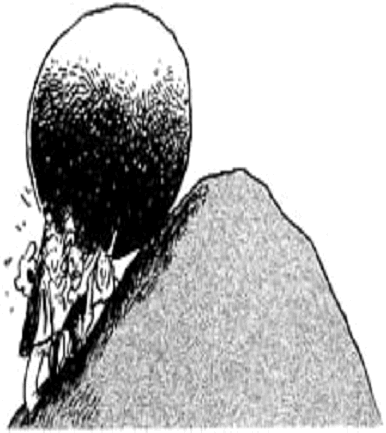 Remember how generating an AP is like pushing a boulder over a cliff to get it over the threshold? With EPSP’s and IPSP’s we have people (excitatory NT’s) pushing the boulder uphill, trying to push it over trying to generate a AP and we also have others (the inhibititory NT’s) pushing it the other way.
Oversimplified stupid example
Let’s say there’s a neuron in my brain that determines whether I buy pizza or not…
Let’s pretend it’s an interneuron (since those are involved with memory, learning, and decision making). Imagine someone walks in with fresh pizza and I go “Wow I want pizza!” It’s going to be pushing the action potential of that neuron to the edge. Then you think maybe I shouldn’t cause I just ate and I’m not even hungry! But then I smell the pizza and I really want it again. Now I’m thinking I have only $2 on me so I really shouldn’t buy the pizza. So should I? There’s factors telling me I should and shouldn’t buy the pizza.
The point is, the way our nervous system allows us to make decisions are with the summation of Excitatory Postsynaptic Potentials (EPSP) and Inhibitory Postsynaptic Potentials (IPSP). It’s like the devil and angel on the shoulders-act.
Temporal summation
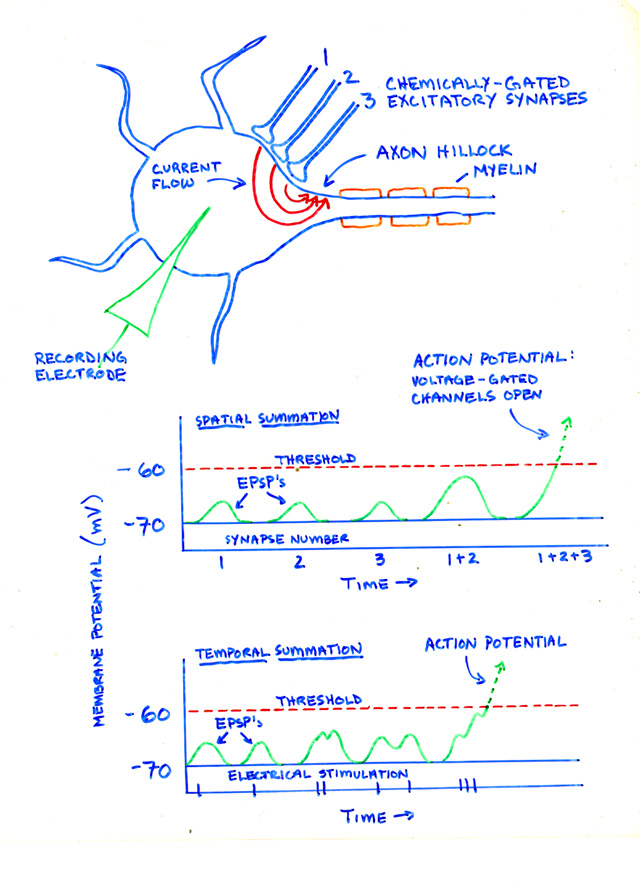
- Temporal summation is the summation of EPSP’s or IPSP’s due to repeated stimulation by one neuron.
- Stimuli applied to the same axon sufficiently close together in time add together to depolarize the membrane.
Look at the picture on the right. The Y-axis of the graphs are Membrane Potential (mV) and it shows that the cell starts out with -70.
At the bottom graph, when one neuron repeatedly fires, affecting a pos synaptic neurons, this is summing in time (temporal summation) that causes an action potential.
What would’ve happened if neuron B released its inhibitory NT repeatedly? It would hyperpolarize more and more, making it more and more negative, making it less and less likely to fire off an AP.
Spatial Summation
There’s also something called spatial summation which is the summation of EPSP’s or IPSP’s due to stimulation by more than one neuron simultaneously.
Top graph: Let’s see what causes a local depolarization (an action potential).
Neuron #1 releases, Neurons #2 releases, Neuron #3 releases. Then Neurons 1 and 2 release. When Neurons 1+2+3 release at the same time, the sodium channels open, we go beyond the threshold potential and have an action potential.
Question: What if neuron A released its excitatory NT at the same time neuron B released its inhibitory NT?
Answer: They would cancel out and there wouldn’t be much difference.

Let’s Connect
The best way to stay up to date with the latest content and videos is to sign up for my newsletter!
Read This Next

Level Up Your Understanding of Shoulder Mechanics!

Cancer Chemotherapy Fact

How come people from very cold climates can visit LA in the winter and walk around in shirts and shorts?