
Cell Respiration Part 2: Aerobic Respiration (Transition Reaction & Kreb’s Citric Acid Cycle)

Transition reaction (Oxidative Decarboxylation)
So from Part 1 (Anaerobic Respiration) we left off with these two pyruvate sugars that were formed in the cytoplasm due to glycolysis. If there’s oxygen, the pyruvate’s go into the mitochondria because aerobic respiration occurs only there. One ATP is required to move these molecules into the mitochondria and this is called the transition reaction because the molecules are transitioning into the mitochondria. We’re basically going to continue breaking the sugar apart into smaller and smaller pieces.
2 Pyruvate sugars + 2 NAD+ —–> 2 Acetyl sugar-CoA + 2CO2 + 2NAD-H2
One carbon is broken off of each 3-carbon pyruvate sugar to form one carbon dioxide. There is a technical name for splitting carbon molecules off the pyruvate to create carbon dioxide and that’s known as a decarboxylation.
The remaining 2-carbon-molecule is now an acetyl group. This acetyl group attaches to Coenzyme A (CoA) to form acetyl-CoA and two molecules of NAD+ are reduced to two NAD-H2.
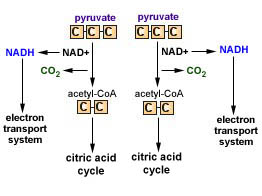
The two molecules of acetyl-CoA then enter the Krebs citric acid cycle while the 2 NAD-H2 molecules carry electrons to the electron transport system for further production of ATPs by oxidative phosphorylation.
Krebs Citric Acid Cycle
The 2 Acetyl-CoA sugars are going to enter a series of reactions called the Krebs cycle, named after Dr. Krebs. It’s aka the citric acid cycle because it uses citric acid.
Basically what’s going to happen is that the 2 acetyl sugars are going to enter the cycle and they are going to be broken apart to form a carbon-dioxide molecule. At the end of the Krebs cycle, there will be no sugar. Four carbon dioxide molecules will form in this cycle. During this process, energy is released to form two ATP’s. This is known as phosphorylation (when a phosphate group attaches to ADP to form ATP). Not only are additional ATP’s formed, but lots of “hot potato” high energy hydrogens are left off from the broken acetyl sugars when they turned into CO2. Six NAD’s are going to pick up pairs of hydrogens (6-H2)and 2 FAD’s are going to pick up a pair of hydrogens (1-H2).
2 Acetyl-CoA+ 6 H2O ——> 4 CO2 + 6 NAD-H2 + 2 FAD-H2 + 2 ATP
Does it seem like more hydrogens were have been removed than originally present from this sugar? Yes, and that’s because 6 H2O molecules come in to accommodate the process.
The reality is that this process actually involves over 10 steps but we are simplifying it for our understanding.
Let’s recap what’s happened so far. Three things:
1. C6H12O2 (glucose) have totally broken down into six CO2 molecules. (Two from transition reaction and four from the krebs cycle)
2. A total of 10 NAD’s have picked up “hot potato” hydrogens and 2 FAD’s have picked up a pair. How did we get 10 NAD’s? 2 NAD’s picked up hydrogen in glycolysis, 2 more in the transition reaction, and 6 more in the krebs cycle.
3. We have a net gain of 4 ATP’s. Two ATP’s were formed in the glycolysis and two more were formed in the kreb’s cycle.
What yet needs to happen?
1. The hydrogens have to be attached to oxygen to form water. We haven’t seen where that happens yet. We’ve only seen coenzymes (NAD/FAD) reduce hydrogens. (Remember, reduction is a gain of hydrogens or electrons.)
2. We need to form as many as 34 more ATP. In reality we might not form that many but the majority of ATP’s have yet to be produced.
To see how this occurs… read part 3 three that involves the Electron Transport Chain!
Cellular respiration
- Anabolic and Catabolic Reactions
- Intro to Cellular Respiration: The Production of ATP
- How Glucose Levels are Regulated in the Blood Stream
- Cell Respiration Part 1: Anaerobic Respiration (Glycolysis and Fermentation)
- Cell Respiration Part 2: Aerobic Respiration (Transition Reaction & Kreb’s Citric Acid Cycle)
- Cell Respiration Part 3: Aerobic Respiration (Electron Transport System)
- The Catabolism of Fats and Proteins for Energy
- The Catabolism of Nucleic Acids
- Oxygen Debt
Let’s Connect
The best way to stay up to date with the latest content and videos is to sign up for my newsletter!
Read This Next

Level Up Your Understanding of Shoulder Mechanics!

Cancer Chemotherapy Fact

How come people from very cold climates can visit LA in the winter and walk around in shirts and shorts?