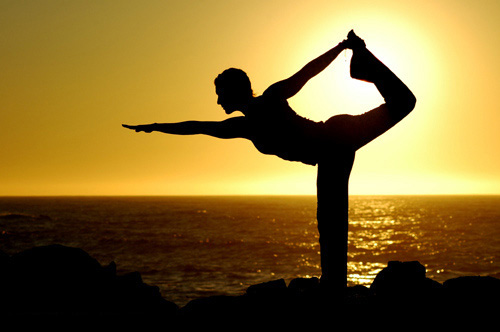
You’re considered a beginner for the first 10 years of your yoga practice.
It’s a very humbling experience to say the least.
Yoga is about enjoying the gradual unfolding process and being aware of how each pose affects the relationship to your breathing. We tend to hold our breath when we are in a stressful situation. Letting go your tension and just maintaining the flow of breathing helps you get deeper into the pose and quiet your mind.
Everybody is different. There’s nothing “messed up” about your back just because it’s more rounded than others. It doesn’t matter that your heels can’t reach the ground when you’re in Downward Dog. I repeat, every-body is different and we are all on our own journey.
Your pose doesn’t have to look like the perfection in the drawings or books. Don’t worry about doing everything perfectly. There is no perfect pose. Alignment is important but yoga isn’t about reaching a perfect pose. Be gentle with yourself and don’t try to make your pose pretty.
How you treat yourself during your yoga session is how you treat yourself outside of it.
- Do you rush through your session?
- Do you immediately give up on a pose after 20 seconds once your feel some pain?
- Do you have trouble going to a yoga class but once you do, you follow through with strong intentions?
- Do you push yourself too hard every time?
Related: How you do anything is how you do everything. Life is one big pose.
Strive to be more ambidextrous from the get-go. You’ll notice one side of your body is sometimes stronger or more flexible than the other. The side that is weaker is the one that needs more time and attention! Note: Practicing ambidexterity is key to making you a better athlete in any sport!
Related: Stand Evenly on Both Feet
Growth is infinite. No matter if it’s your tenth time doing downward-dog or your thousandth time, you will always discover something new about that stretch. In other words, you could get something out of each pose, no matter what level you are at. As you progress deeper into a pose, it transforms into a different stretch and this process is infinite.
Let go your head! When you’re in downward dog, or standing forward bend, simply nod or shake your head to let it fall! Shaking or nodding your head makes your neck immediately surrender to gravity.
When you’re in Warrior 1, if your left foot is in the front, your bum will tend to go out toward the left. Move it to the right, draw the inner thighs closer together and you’ll feel a new stretch (possibly the hip flexors). Conversely, if your right foot is the front one, move your butt to the left (toward the midline).
When you’re in Warrior 2, look over your fingers and SMILE! This makes any distressful pose become ridiculous.
Little earthquakes (tremors) are there to remind you that you are alive when you’re being pushed to the edge.
Be Here Now… On Vacation! You may have to do things later but when you’re doing your practice, don’t worry about it. Let your thoughts roll by as you just focus on your breath and stay in the present moment. Treat this hour or two in the studio as a vacation.
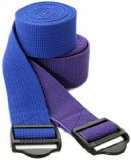
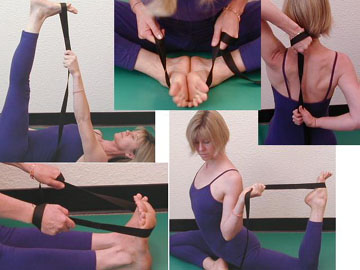
Yoga Straps are a godsend for beginners. Yoga belts/straps (pictured on the right) allow you to grasp limbs that you couldn’t normally reach and help you hold the pose longer. You get much deeper into a pose and stretch much more effectively with them. I recommend Yoga Accessories 8′ Cotton Straps because they’re long enough for nearly everyone!