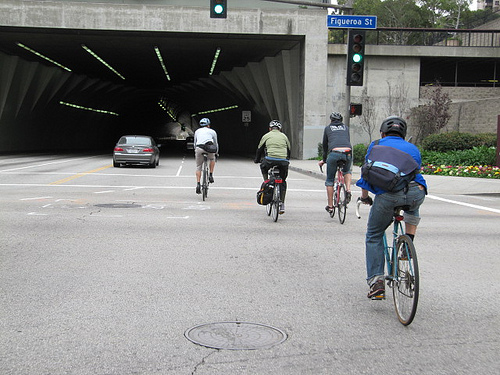
Riding your lovely bicycle in a car-centric city such as Los Angeles can be very stressful if you don’t know the best way to ride with each other. There’s far too many cyclists who are constantly riding on the sidewalks and too many drivers who honk at me to get out of their way. I believe I’ve been accident-free (and ride stress free) because I always ensure that I am visible and following the rules of the road, the same way a car would.
If this article has the potential to educate even just a few people to ride properly (and a few drivers to simmer down), then I am ALL for it.
You are a slow-moving vehicle.
So first things first, let’s get something straight: cars are vehicles, but bicycles are vehicles as well. When you are riding your bicycle you should follow the rules of the road the same way cars do. Creating your own rules out of thin air creates confusion for everybody. You must integrate yourself with the rest of traffic as if you are a slow-moving vehicle, because that is what you are.
Never ride against traffic.
Nobody would drive their car on the wrong side of the street, so why would you do that on your bicycle? Just because you can’t see behind you, doesn’t mean that cars are going to rear-end you. There are many reasons why this is very dangerous.
- Motorists pulling out of driveways and looking to merge onto the street do not bother to look for cyclists coming from the completely opposite direction. You will be invisible to them until it’s too late!
I actually made a separate rant about salmons cycling upstream because it’s such a bad problem.
- If a car is driving at 30mph and you’re bicycling at 10mph and you are both riding in the same direction and there is an impact, the closing speed would be 20mph. If you’re both riding toward each other, the closing speed doubles to 40mph! When the closing speed doubles, the force of impact increases by four times, and when the closing speed triples, the force of impact increases by nine times. In other words, if an impact occurs when you are riding against traffic, it could be much more harmful than if you were going in the same direction.
- To make matters worse, both you and motorists have much less time to react if you’re going toward each other and the situation may become particularly confusing (read: dangerous) for everybody involved. So please, ride with the normal flow of traffic!
Avoid sidewalks like the plague.
Even though ignorant motorists will yell at you to get on the sidewalk and police will usually ignore you and not cite you for riding there, it is a horrible idea to ride on the sidewalk. Sidewalks were NOT created for bicycles. Sidewalks are for pedestrians! Please don’t imitate those cyclists who are riding there because they are DOING IT WRONG!
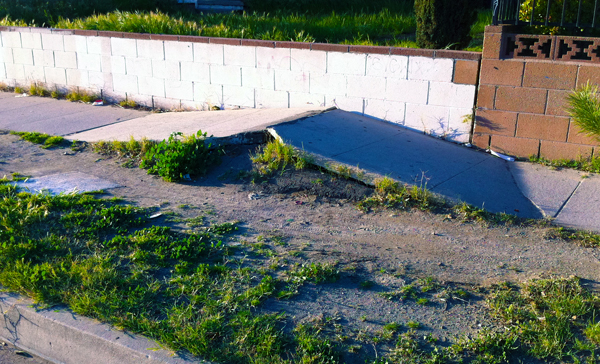
Riding on the sidewalk is extremely stressful. You will not be able to truly relax because you constantly have to avoid benches, bus stops, pedestrians, cracked pavement, tree roots, poles, fire hydrants, low hanging tree branches, and so forth. There is barely enough room for two pedestrians to walk side by side, let alone a cyclist to get through. Pedestrians usually have no idea a cyclist is coming up behind them and there is no easy way to alert them (or direct them), especially if they have headphones in and are listening to music.
The danger of a car suddenly darting out of a driveway and hitting you while you are cycling on the sidewalk is very scary, because it’s real. A motorist pulling out of a driveway almost never stops before the sidewalk to check if the sidewalk is clear. They will go right over the sidewalk and stop just before the street to see if there are any cars coming. If any cyclist is on the sidewalk at the same time a car is pulling out, the chance of a collision is very real (and exacerbated like crazy if you’re riding in the wrong direction)! Pedestrians don’t experience this issue because they are walking at only 2-3mph and have plenty of time to yield.
In California there are several cities that have made it illegal to ride on the sidewalk. If you get in an accident, you have no legal claim whatsoever. Insurance companies are not going to pay and you may even have to pay for any damage you did to a pedestrian or car on top of your own medical bills! 😮
Sidewalks are so dangerous that if my only choice was to bike there, I would’ve never gotten into bicycling. So, what do you do if you shouldn’t ride on sidewalks? The only place left is the street.

You have a right to be on the streets.
You have as much of a right to ride on the road as any other car. Understand that you aren’t blocking traffic when you’re on the street, you are traffic. California law is completely on your side for this. You must follow the same rules of the road as if you were driving a slow-moving vehicle. Riding on the street allows you to ride a lot more relaxed than the sidewalk ever could.
Learn to look behind you without swerving.
This is crucial: learn to hold your line while looking behind you. “Hold your line” is a phrase unique to cycling that means keep your steering straight. When you look behind you, your steering will naturally change as well if you’re not experienced. Please practice looking over your shoulder while keeping your steering straight. Practice it for both sides; strive to be ambidextrous.
Looking behind you is crucial when you want to make a left-turn:
- You need to check if it’s clear before you switch lanes.
- If there’s too much high speed traffic and you can’t get to the left-turn lane, you can always pull over and use the cross walk like a pedestrian.
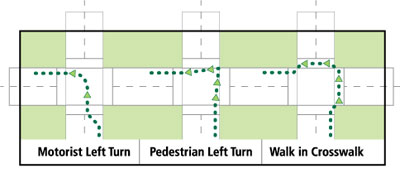
Learn to look behind you without swerving [because everyone is texting A LOT nowadays].
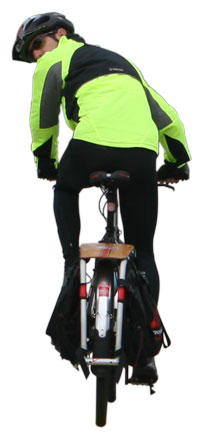 I am saying this AGAIN because it’s THAT important! You MUST get comfortable with looking behind you. So comfortable in fact that you make EYE CONTACT with the drivers behind you. This eye contact is what will SAVE YOU one day. Drivers nowadays have their attention split between their phone and the road. When they are glancing up at the road they are often missing crucial details, like the fact that there’s a cyclist up ahead! But subconsciously something happens when you make eye contact with them. They pick up on that detail. You are not just a cycling anymore when they see you: they see your face, they see you are human. (It’s kind of like how you may subconsciously note a car in your peripheral vision that’s got black and white markings that warn us that might be a police officer!)
So anyway, I’m just trying to drive home the fact that you need to get really good at constantly looking behind you in precarious situations. You have to be vigilant and defensive in your right to use the road and protect yourself!
Ride clear of the door zone. Ride on the left side of the bike lane.
You must not ride closer than 4 feet from parked cars. This area is known as the door zone because you can crash into a door that suddenly opens in front of you. While it is the drivers and passengers responsibility to make sure they open the door when it is clear to, one mistake can result in a horrific, if not fatal, accident.
Poorly designed bike lanes often create the illusion of ensured safety. They are often improperly placed right next to parked cars, almost entirely within the door zone. Ride on the left side of the bike lane to avoid the door zone if you need to.
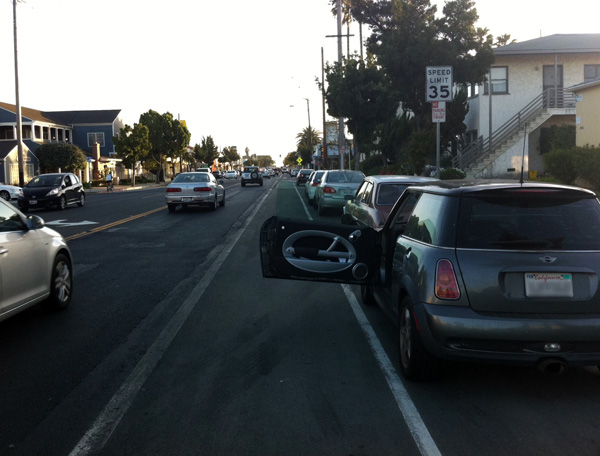
By the way, if a parked car has their brake lights on and you are wondering if they are going to pull out and potentially run over you, stare at their wheels as you pass by them because it’s very easy to tell if wheels are moving. (If you stare at the car overall, it’s actually very hard to tell if it’s moving at all because you’re moving relatively fast.)
The edge of the road starts where there is no debris and is clear of the door zone.
Notice how all the trash tends to collect along the edge of the street? Don’t ride there. The right edge of the roadway, legally for a cyclist, starts where there’s no debris, water, pot holes, gravel, glass and where it is clear of the door zone. Riding over a small nail or glass could be enough to cause a flat. That single white line on the very far right is not intended to be a little lane for cyclists. It simply denotes the shoulder and is not a bike lane.
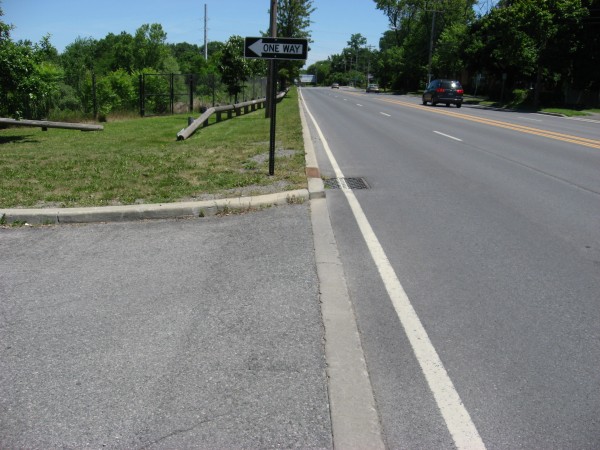
More often than not, lanes are not wide enough to be shared.
Most of the roads in Southern California have narrow lanes that are not wide enough to be safely shared by a car and bicycle at the same time. Plenty of streets have lanes that are just barely wide enough for a car alone! You can’t ride on the very far right due to trash/debris, you need to avoid the door zone and a car needs to give you a few feet of space to pass by you, so more often than not, lanes are not wide enough to be safely shared.
Take the Lane: Ride on the left side of the right lane.
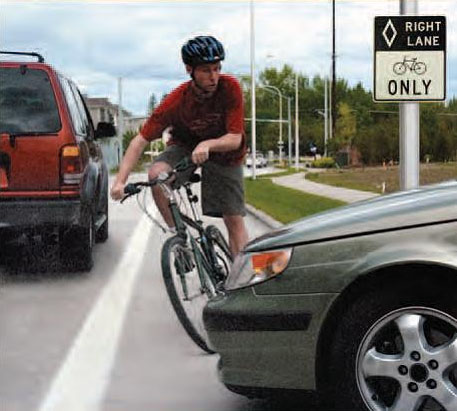
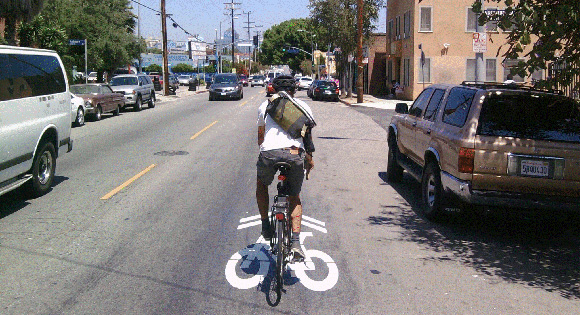
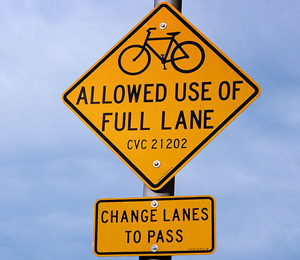 If there is no bike lane and the right lane is less than 14 feet wide (the width of 2 cars), the best place to ride is on the LEFT side of the RIGHT lane. This is known as “taking the lane.”
This is the safest, most relaxing, most stress-free and fastest line you could take.
Riding on the LEFT side of the RIGHT lane makes a bold statement that this lane is not shareable and ensures your visibility. Drivers get the hint from a distance that they need to change their lane because they can’t squeeze past you. You have to be confident that you are doing the right thing and the law is on your side.
Most drivers are completely oblivious to the specific hazards that cyclists need to avoid (door zone, pot holes, sewer grates etc) and think you should always ride as far to the right as possible. Don’t concede to their ignorance. As a cyclist you need to do the right thing and protect yourself. You must assert yourself and ride defensively by taking the lane. It will make you predictable, visible, and send the clear message that this lane is not wide enough to be shared.
Here’s a video demonstrating why taking the lane would be appropriate in this case
But Anto, Why the left side? Why not the middle or the right?
1. Drivers see it as an invitation to squeeze past you: If you ride on the right side, I guarantee that drivers are going to try to squeeze past you when it is not safe to do so. You will undoubtedly fear for your life during those very scary moments when you are getting dangerously squeezed past by a car AND are riding in the door zone AND are going over pot holes. You will never experience that if you are taking the lane.
2. You will get cut off: If you ride in the middle, I guarantee a driver will prematurely cut you off. They will perform what is known as lane-splitting, meaning they will only put half of their car in the other lane, accelerate and then cut back into your lane before they have completely passed by you. You need to ride on the left so they know they have to completely clear you before they can get back in the right lane.
3. You send a clear message to drivers and prevent delay: When you make it very obvious that the lane is not shareable, drivers get the hint up to a quarter mile away and will change their lane hundreds of feet ahead of time. If you ride in the middle or right side, drivers won’t know they can’t squeeze past you until they get very close to you, causing indecisiveness and delay. Or worse, they will try to squeeze through anyway as I said in point #1.
4. Visibility / Line of sight: The further away you are from the curb, the better other drivers can see you, especially the ones pulling out of side streets, driveways and parking lots.
5. Predictability reduces ambiguity. Who is safer? The cyclist who goes from the sidewalk to the street and back to the sidewalk with no rhyme or reason or the cyclist that confidently takes the lane and holds their line, minimizing any ambiguity? Riding on the left has the least hazards and you can easily maintain a straight line.
If you are on a narrow, single lane road and there are more than 5 cars backed up, then you should pull over and let them all pass through, the same way a slow vehicle would legally have to utilize a turn-out. Cyclists abide by the same rules as a slow-moving vehicle. (See: Vehicular Cycling)
Chill out when drivers honk at you.
Now, what’s guaranteed to happen is that drivers are going to honk at you. These people are most likely ignorant of the law, don’t know what it’s like to commute on a bicycle, and completely oblivious to the specific hazards that cyclists face. These people are also often very angry. Not at you, just at the world. Probably because they are stuck in traffic in a car. 🙂 You are just another opportunity (an excuse) for them to project their stress onto you.
Try not to react. They will just speed away past you like a pissed off 12 year old.
I pity how stressed out, irrational and stupid they seem all at once. A driver just needs to press on a pedal to go forward and can change a lane with just a finger, yet they honk at cyclists, who are powering the bicycle with their own legs and expect them to pull over. Sorry, no can do. I drive all the time too, I know what it takes to change a lane: Nothing. There’s no reason to go crazy over it.
If anyone starts threatening you, you can always pull over and take out your cell phone immediately. Seeing the cell phone may scare them off. If they try to run you off the road, try to get their license plate number and call 911 immediately to report it in. Los Angeles was the first city in the US that passed a cyclists’ anti-harassment law that protects you from aggressive drivers. Yelling, honking, passing too close, swerving toward a cyclist, throwing objects at them, and so forth all quality as harassment. This law makes it easier for you to pursue justice in civil court, seek punitive damages and lawyer up. Hopefully that never happens!
Well, that should cover the basics pretty well. If you have any questions please don’t hesitate to ask. I would love to answer them! And if you enjoyed reading this article, please check out the home page of my website for more featured articles which change all the time!
Highly recommended for cyclists: How To Get Rid of [Muscle] Knots