Last year I took a human anatomy class and it turned out to be one of the coolest classes ever! I started thinking differently about my body in so many ways, partly because of the content but mostly because my professor was one of the most knowledgeable and down to earth human beings ever. I picked up on a few really interesting things that I thought would be cool to share with all of you. Hope you find them as fascinating as I did!
1. Where do your the tears come from and what do they drain into? You might be surprised by this answer!
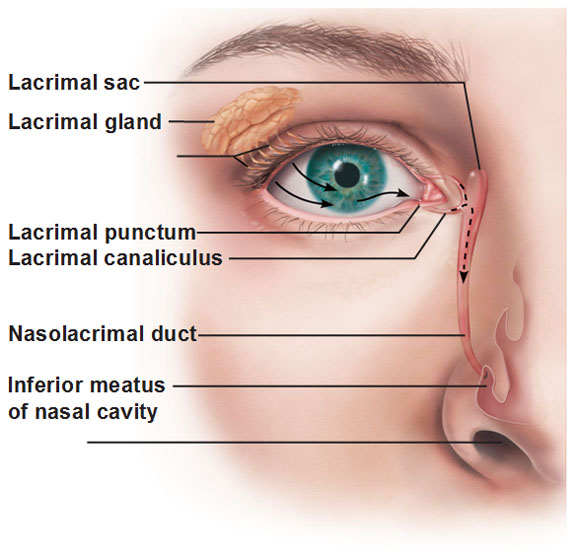
We normally think our tears come from the inner corners of our eyes because when we cry, tears run down from there. However, that’s not true at all. Look at the picture to the right. The lacrimal gland, located just above your eye, is what produces tears all day. A constant stream of tears washes across the eye (follow the arrows) to keep it moisturized.
There are minute holes in the inner corner of your eye (the puncta) that are constantly draining tears into the nasolacrimal duct that empties into your nose. So when someone starts crying, the reason we see the tears coming down the inner corner of the eyes are because the little holes can’t drain the excess tears fast enough so it overflows and runs down the face. Whatever makes it down the holes ends up in your nose. This is also one of the reasons why your nose may get runny when you start crying or put eyedrops in.
2. Your bones are actually living, breathing tissue, just like the rest of your organs.
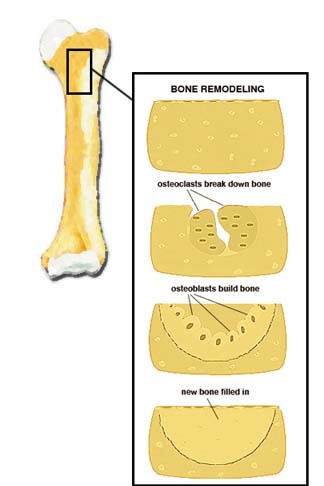 Bones may seem static and unchanging, as they are hard and cannot bend easily, but your bones are living tissue just like anything else in your body. In fact, they are constantly going through a process known as remodeling.
Remodeling: When stress is placed on your bones in the form of impact, signals are sent to certain cells (osteoclasts) to BREAK DOWN that part of the bone and then REBUILD it in response to the stress you put on it. In fact, a bone is shaped the way it is due to all the stresses placed on it. Bone markings, like ridges or crests, indicate muscle attachment points and the more that muscle is used, the thicker those protuberances on the bone become.
As an adult, about 10% of your skeleton is replaced every year. If you are trying to do yoga and cannot do certain moves because your hips are too tight, don’t worry, keep trying. Your skeleton is very much alive and responsive to the demands you give it.
If you don’t put any stress on your bones, they will simply break down without being rebuilt and, overtime, can lead to osteoporosis. That is why when people, especially women, get old and have avoided doing any sort of exercise all their life, they will eventually break a hip just by bumping into a wall.
3. Why do kids get ear infections more often than adults?
There is a very purely anatomical reason for why ear infections are so much more common for kids than adults. Okay, now pay attention.
Inside your ear you have an ear drum which is called the tympanic membrane. Behind your nose is the start of the pharynx, which is the tube that leads down into your mouth and goes into your digestive system. Inside your ear, there is a tube that connects this tympanic membrane to the pharnyx, logically named the pharyngotympanic tube.
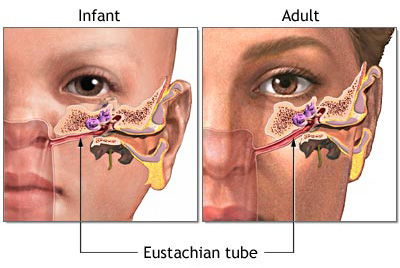
Look at the picture above for reference: This is the tube that equalizes the pressure in your ear with the ambient air. Another equally important function of this tube is to drain infections, away from the ear and down into the pharynx. Since a child’s skull is physically smaller than an adult’s, the angle of this tube, from the ear to the pharynx, is much more horizontal. As a result, the fluid doesn’t drain down as easily and that’s why ear infections accumulate in kids more often than adults.
4. How do veins return blood back up to the heart from the lower legs, against gravity, long after blood pressure from the heart has dissipated?
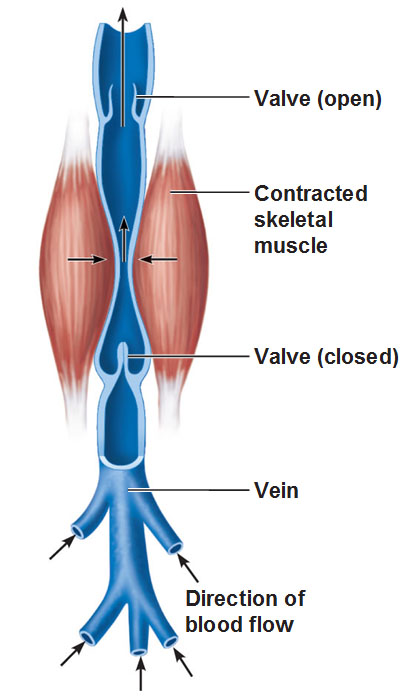 Arteries are the vessels where blood is pumped out away from the heart to go toward the rest of the body. Veins are what carry blood back to the heart.
Blood pressure in your arteries, where it initially exits your heart, is very strong. This pressure helps the blood enter the capillaries but by the time the blood leaves the capillaries and enters the veins, the blood pressure is now very low. The pressure from the beating heart has dissipated dramatically but the veins need a practical way to move blood from the lower legs back up to the heart, against gravity.
The body uses something known as the skeletal muscle pump: Muscles surround the veins which contract to massage the vein and coax the blood to continue moving. Inside the veins are valves that are arranged in such a way that when the blood starts to fall, they shut down and prevent back flow.
If you’re confined to a seat, such as on an airplane or long car ride, you could help your blood circulation by flexing the muscles in your legs. Wiggle your toes, rotate your ankles, flex your calves, and then flex your thighs and your butt. If you do this repeatedly in that order it will literally help shoot the blood back up to your heart.
5. Ever notice most of your skeletal muscles work in antagonistic pairs? Why is that?
Most of the skeletal muscles on our body come in “antagonistic pairs.” The reason for this is because muscles can only contract. For example, when you bend your elbow, you can do that because the muscle fibers in your biceps shorten, bringing your arm closer to you. The only reason you’re able to straighten your arm back out is because your triceps muscle, behind the biceps, contracts and shortens, causing the biceps muscle to relax.
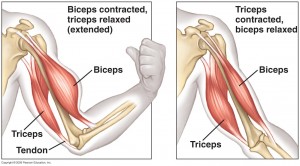
Another example of an antagonistic pair? Our abs help us lean forward while the muscles in our back help us straighten our back up. The quadriceps (the muscle on top of your thigh) extend your knee while the hamstrings (the muscle under your thigh) bend your knee. So you get the idea. By the way, our hamstring muscles are generally very ‘tight’ because we only stretch them for a few minutes a day (if even that) and the rest of the time we do everything else to make the hamstrings tighter. Sitting OR standing, for example, make your hamstrings short and tight. It’s only when you try to stretch them using other muscles, is when they actually relax and loosen. Moral of the story? DO SOME YOGA. 🙂
Check out Part 2: Four More Fascinating Things I Learned in Anatomy Class